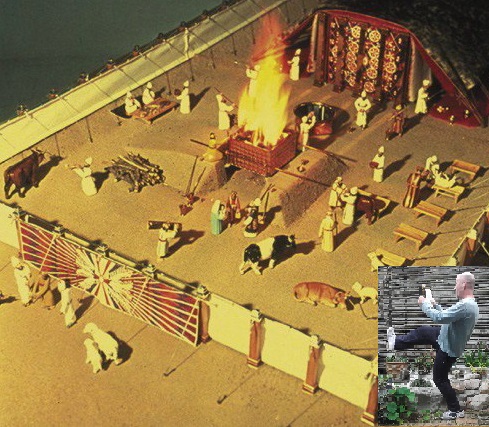
“If we deliberately keep on sinning after we have received the knowledge of the truth, no sacrifice for sins is left, but only a fearful expectation of judgment and of raging fire that will consume the enemies of God. Anyone who rejected the law of Moses died without mercy on the testimony of two or three witnesses. How much more severely do you think someone deserves to be punished who has trampled the Son of God underfoot, who has treated as an unholy thing the blood of the covenant that sanctified them, and who has insulted the Spirit of grace? For we know him who said, “It is mine to avenge; I will repay,” and again, “The Lord will judge his people.” It is a dreadful thing to fall into the hands of the living God.” (Heb 10:26-31)
This most uncomfortable of verses strikes a death blow to the nonsensical teaching I’ve heard that the God depicted in the Old Testament is a God of wrath and punishment, whereas the God depicted in the New Testament is a God of love and forgiveness. This verse, talking of wrath and punishment, comes from the New Testament not the Old.
In the church, we easily understand and accept that the love of God is shown in fuller and clearer expression in the New Testament; the Old Testament sacrificial system that temporarily mediated God’s forgiveness and mercy is gloriously eclipsed by Jesus’ full and final sacrifice of Himself.
But we go wrong when we think that this fuller and clearer manifestation of grace necessarily shrinks God’s wrath and punishment.
This is sentimental, simplistic and magical thinking. It falsely reasons that since God is God he can simply choose to ignore sin and magically wave it away; as if God, being God, can simply choose to make 2 + 2 = 5. As if God is simply being mean, rather than loving and consistent, when he doesn’t break His own laws. It ignores that such inconsistency creates a hellish not a heavenly reality.
This magical attitude thinks that people who actively choose to place their selfish will and ego above God and all other human beings (thus breaking Jesus’ two great love commands) will suddenly stop doing that and will fit into God’s renewed Heaven and Earth without corrupting it.
The root of this magical thinking is humanism, which thinks that all people are good but misunderstood, pure but corrupted by parents and society.
The Bible is clear that God is love and is not willing that any should perish: “The Lord is not slow in keeping his promise, as some understand slowness. Instead he is patient with you, not wanting anyone to perish, but everyone to come to repentance.” (2Pe 3:9)
However, God will not override human freedom. Consequently, people “perish because they refused to love the truth and so be saved” (2 Th 2:10).
As CS Lewis said: “There are only two kinds of people: those who say to God, ‘Thy will be done,’ and those to whom God says, ‘All right, then, have it your way.’”