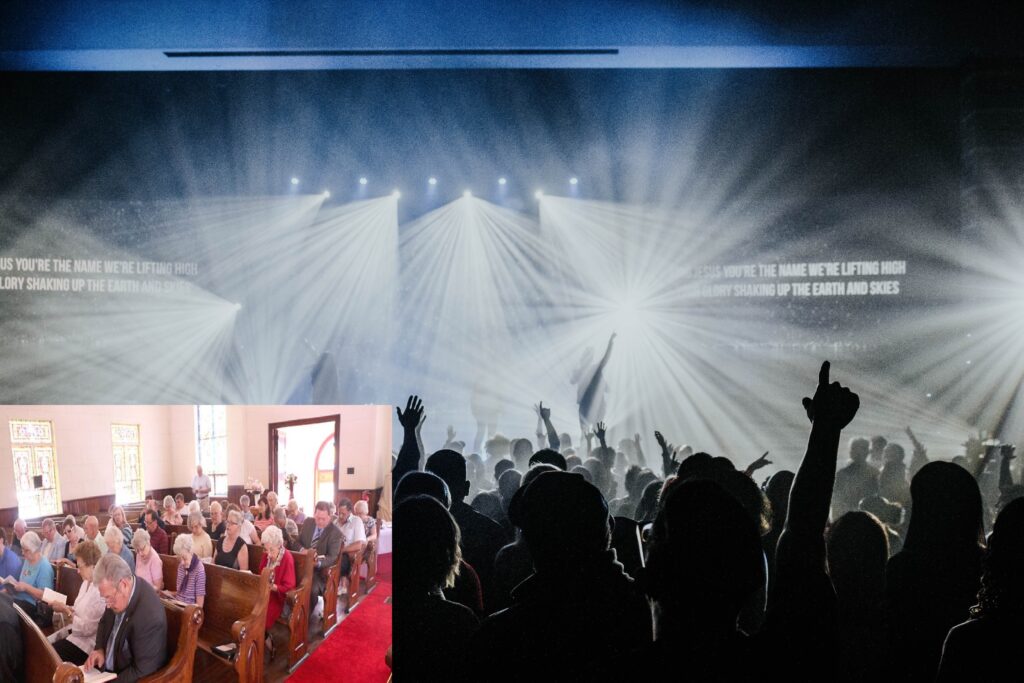
DIVERGENT THEOLOGIES LEAD TO DIVERGENT GOALS
Of the many different divisions or contrasting traditions in the church, I am particularly interested in the liberal versus conservative and Reformed versus Charismatic expressions of Christianity. The specific values, theology and methods of the various groups play out in different vison, goals, methods, and strategies.
I acknowledge that all typologies are an oversimplification and cannot do justice to the realities or motives of any group. Nevertheless we cannot avoid them as a step in the process of knowledge and ministry. The goal is not merely to critique, but also to discover and affirm strengths, and all this as part of the larger process and quest for wholeness, that God has commanded throughout Scripture (Mat 5:48, Mat 19:20-21; Luk 6:40; Col 1:28; Jas 1:4).
The strength of liberal goals will be a focus on humanization, culture, and this present creation, the very areas of lack that often exist in conservative culture and goals.
On the other hand, liberal expressions can learn from the following aspects of Scripture, which conservatives take seriously: the quest for robust relationship wth a real, transcendent God, holiness and a respect for God’s unchanging moral laws, and a focus on God establishing His Coming Kingdom.
THE FULLNESS AND CLARITY IN SCRIPTURE.
I believe a complete and deep reading of Scripture shows that God does not leave us in the dark, and repeatedly explains what our goal in religion should be (Deut 10:12-13; Ecc 12:13-14; Jer 7:22-23; Mic 6:8; Isa 1:12-17, Isa 58:6-10; Zec 7:9-10; Zec 8:16-17; Mar 12:28-31; Luk 6:35-36; Joh 15:8-13).
It is interesting how the various verses, taken together, do not separate love for God from love for neighbour, love for heaven from love for earth, righteousness as avoiding sexual and other immoralities from righteousness as working, and suffering, for social justice.
If we take just one verse, James 1:27:
Jas 1:27 Religion that God our Father accepts as pure and faultless is this: to look after orphans and widows in their distress and to keep oneself from being polluted by the world.
I don’t think it is an unfair characterization to say that liberals versus conservatives will respectively place a different focus on orphans and widow versus pollution by the world. Liberals will make the care of orphans and widows the main point of the verse and underemphasize avoiding sin and contamination by the world’s culture, and conservatives will have the opposite focus. By their respective selective focus on one aspect at the expense of the other, both groups are doing violence to the linguistic structure and moral intent of the verse. God expects us to focus on both and a deep and pure understanding of religion will see that these two areas of focus are inextricably linked.
REFORMED VERSUS CHARISMATIC
The other major fault line, between Reformed and Charismatic, also plays out in divergent goals.
“Discovering God’s will for your life”, “walking in your Kingdom purpose”, “doing the works of Jesus”, “facing the giants in your life”, and “gaining your inheritance” are goals that are not only natural but are in many ways the life-blood of Charismatic churches.
Reformed type churches will not merely have less focus on these goals, they may even actively oppose them as fleshly enthusiasm and deception.
I do share the Reformed church concern for the Sovereignty and holiness of God and the authority of Scripture. Furthermore, I believe that much of what happens in the charismatic churches is more based in emotional, subjective categories and goals (identical to popular culture) than the Bible and the Holy Spirit. In addition, much of the triumphalistic prophecy and visioning doesn’t come to pass and this gets swept under people’s emotional and mental carpets.
However, it is precisely because of my high view of God’s sovereignty and holiness and my commitment to the authority of Scripture that I believe that the goals of charismatic churches are valid and to be pursued.
If some pursue the gifts of the Holy Spirit in fleshly ways, and others have an irresponsible culture of Kingdom visioning and goals (a culture that is superficial, does not deliver promised results, and fails to be accountable for this discrepancy), then the answer is not to retreat into a safe, controllable hyper-Reformed culture (a cessationist culture where the gifts have ceased and one conveniently does not have to deal with all the messiness that goes with them).
CALM THE FIRES WITH THE TRUTH OF SCRIPTURE.
This is a highly volatile subject that gets people very upset, but we have to stay with the fullness and balance of Scripture, as evidenced in just a couple of the many available verses:
1Co 14:39-40 Therefore, my brothers and sisters, be eager to prophesy, and do not forbid speaking in tongues. (40) But everything should be done in a fitting and orderly way.
1Th 5:19-22 Do not quench the Spirit. (20) Do not treat prophecies with contempt (21) but test them all; hold on to what is good, (22) reject every kind of evil.
A CALL TO CEASE CESSATIONISM.
My stance is firmly anti-cessationist and the fullness and balance shown in these Scriptures remains relevant today. The fact that cessationism versus anti-cessationism completely affects interpretation and practice makes it an urgent issue to address.
Like the noble Berean Jews (Act 17:11), we must examine the Scriptures and follow the goals and practices that are outlined there, refusing to add to them and refusing to take from them (Deut 4:2, 5:32-33; Mat 15:3-6; 1Co 4:6; Rev 22:18-19).
We need to be very careful not to maintain a practice that God has fulfilled and declared to be irrelevant (such as old covenant food laws, to take just one of many examples: Mar 7:18-19; Act 10:13-15). Equally, we must fear declaring something fulfilled and passed away, before God has actually caused this to be the case. This is what I believe cessationist teaching has done through a misinterpretation of 1Corinthians 13:8-10, identifying the completion of the Scriptural canon as the completeness that signals the passing of the gifts:
1Co 13:8-10 Love never fails. But where there are prophecies, they will cease; where there are tongues, they will be stilled; where there is knowledge, it will pass away. (9) For we know in part and we prophesy in part, (10) but when completeness comes, what is in part disappears.
This misinterpretation has been to the loss of the church and the world, who need all of God’s gifts to be fully functioning right until the job is fully completed, right until the true completeness referred to in verse 10, right up to the moment that Jesus returns to complete and restore all things (Act 3:21).
BACK TO THE FULLNESS OF SCRIPTURE, NO MATTER WHAT IT COSTS US.
This difficult challenge of not going to the left or right, not adding or subtracting, neither obstinately holding nor prematurely discarding, must be undertaken, no matter the cost to our cherished beliefs, traditions, structures, goals, or personal temperaments (Luk 14:26-27, 33).
I believe we need to actively pursue all goals and practices that are clearly outlined in Scripture as well as those that are not necessarily spelled out in Scripture. Those that are not actively spelled out in Scripture need to be resonant with the values of Scripture, and need to bear fruit in terms of the threefold criteria of how they affect our understanding and commitment to Jesus, Scripture and the Church. Furthermore, they need to have a valid history and current expression in churches committed to Jesus, Scripture and the Church.
Consequently, I think healthy churches will teach on our inheritance in Christ as well as on God’s sovereignty, on counselling as well as preaching, on suffering as well as on praying for physical healing, on the gifts of the Spirit as well as on reading the Bible, on the Toronto Blessing as well as on the Reformaton.
On the day of judgment we don’t want to be found guilty of embracing that which is not of God nor of rejecting that which is.
1Th 5:19-22 Do not quench the Spirit. (20) Do not treat prophecies with contempt (21) but test them all; hold on to what is good, (22) reject every kind of evil.
Mar 7:13 Thus you nullify the word of God by your tradition that you have handed down. And you do many things like that.”
Mat 15:13 He replied, “Every plant that my heavenly Father has not planted will be pulled up by the roots.