A few weeks ago, a gold crown on my molar fell out; “this is not good”, I thought. The next day the remaining part of the tooth cracked. I bore all this nobly and quietly because I am courageous and uncomplaining, and also because this root-canal treated tooth had no nerve.
When I finally got to the dentist, I was wary because this same person had almost extracted the wrong molar a year ago: Me: “Why are you injecting on the top, it’s the bottom tooth?” Dentist: “No it’s the top tooth.” [Checks x-rays and sees mistake.] This is the chance to say, “Oh my goodness, I’m so sorry, …”, but instead, without blushing or batting an eyelid, says “we must keep an eye on that top tooth”, and continues. A successful future in politics awaits, methinks, should the practice tank.
An hour and fifteen minutes later, after much jiggling and wriggling, huffing and puffing, and alternating of instruments and heights and angles of the chair, all three fragments of the tenacious critter were out. “Boy that was a mission!” is not what you want to hear your dentist say. By that stage I was starting to feel the need to drink some sugar water, or something stronger.
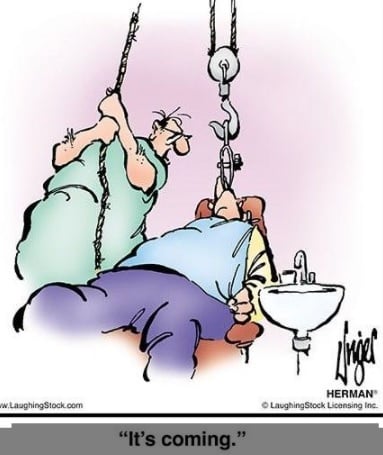
The actual physical pain was minimal. Due to the marvels of modern science and technology, not only do we get an injection to block almost all pain, we also get a numbing gel to block the pain of the injection (wow, not just toilet paper, but double-ply with pretty patterns!). Furthermore, as the dentist proceeded and found areas that still twinged, further injections followed. A nobler person would have done without the additional injections, but I was only too happy. In fact, if I was offered something to distract me with psychedelic visions of flitting polka-dot neon butterflies throughout the whole process, I would have said, “yes please, make that a double!”
I don’t watch horror movies, but Tom Hanks’ removal of his rotten tooth with an ice skate and a rock in the “Castaway” movie is plenty horror scene for me. My aversion to pain makes me grateful I don’t live in medieval times where pain killers and instruments were crude and rudimentary and surgical procedures had as good a chance of killing you as of curing you.
As always, my thoughts and experiences lead me back to Jesus and a reflection on the significance of his life, passion (or suffering), death, and resurrection.
Critics of Christianity are correct when they point out that the physical pain of Jesus’ death was not ultimate or exceptional, and one can find many examples of far more painful and lingering deaths in past and present history.
The point, however, is that, as many of us know -from our own experiences of loss, disappointment, betrayal, and injustice-, non-physical pain is the greater and more devastating kind. And Jesus went far beyond even that, to bear a unique cosmic, spiritual pain. He absorbed, fully experienced and….mystery of mysteries…cleansed/ destroyed / dissipated / rendered null-and-void-and-impotent, all the sin and resultant pain and suffering, and, ultimately, death, of the whole world. Whoever freely identifies with Jesus and does not resist the divine invitation to become one with Him in covenant union, receives the full benefit of these acts (and experiences these benefits to the extent that they commit and grow up in their faith).
I have a strong image in my mind of a filthy river of all past present and future human sin, rebellion and injustice. It looks like a black, bubbling brew filled with environmental waste, abused and broken human bodies and body parts, crumpled and torn papers reflecting broken contracts and promises, and every other imaginable horror, artefact, and instrument of human depravity. This river flows directly into Jesus’ pierced side as he hangs, bleeding on the cross. Behind the cross, flowing out of Him, is a clear, crystal stream become a torrent. It reminds me of the river described in Ezekiel 47:1-12, reaching into every nook and cranny of the creation, which is the same river described in the final stages of the Grand Biblical Narrative, in Revelation 22:1-5
The Old Testament prophecies of Isaiah, given around 700 years before Jesus’ birth, accurately describe this work that Jesus came to do:
Isaiah 53:3-6 He was despised and rejected by mankind, a man of suffering, and familiar with pain. Like one from whom people hide their faces he was despised, and we held him in low esteem. (4) Surely he took up our pain and bore our suffering, yet we considered him punished by God, stricken by him, and afflicted. (5) But he was pierced for our transgressions, he was crushed for our iniquities; the punishment that brought us peace was on him, and by his wounds we are healed. (6) We all, like sheep, have gone astray, each of us has turned to our own way; and the LORD has laid on him the iniquity of us all.